No products in the cart.
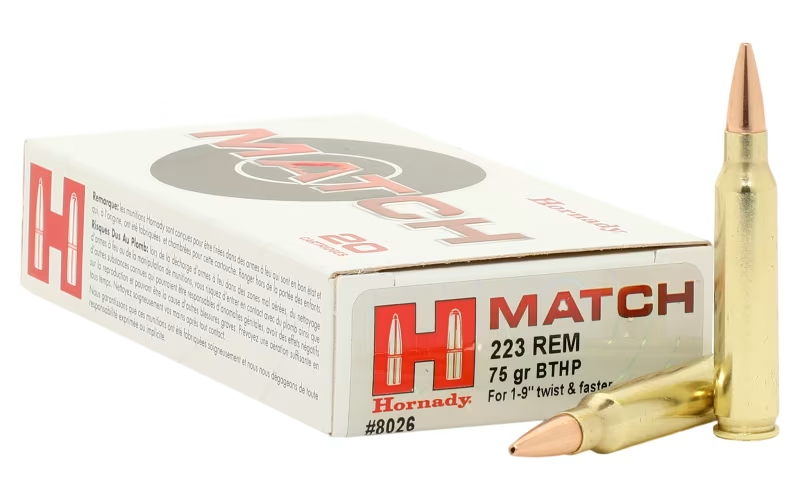
Buy .223 Rem Match online
Price range: $700.00 through $3,200.00
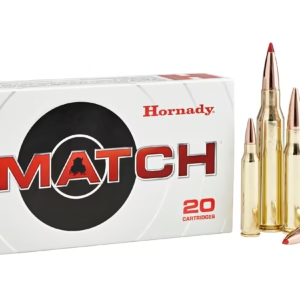
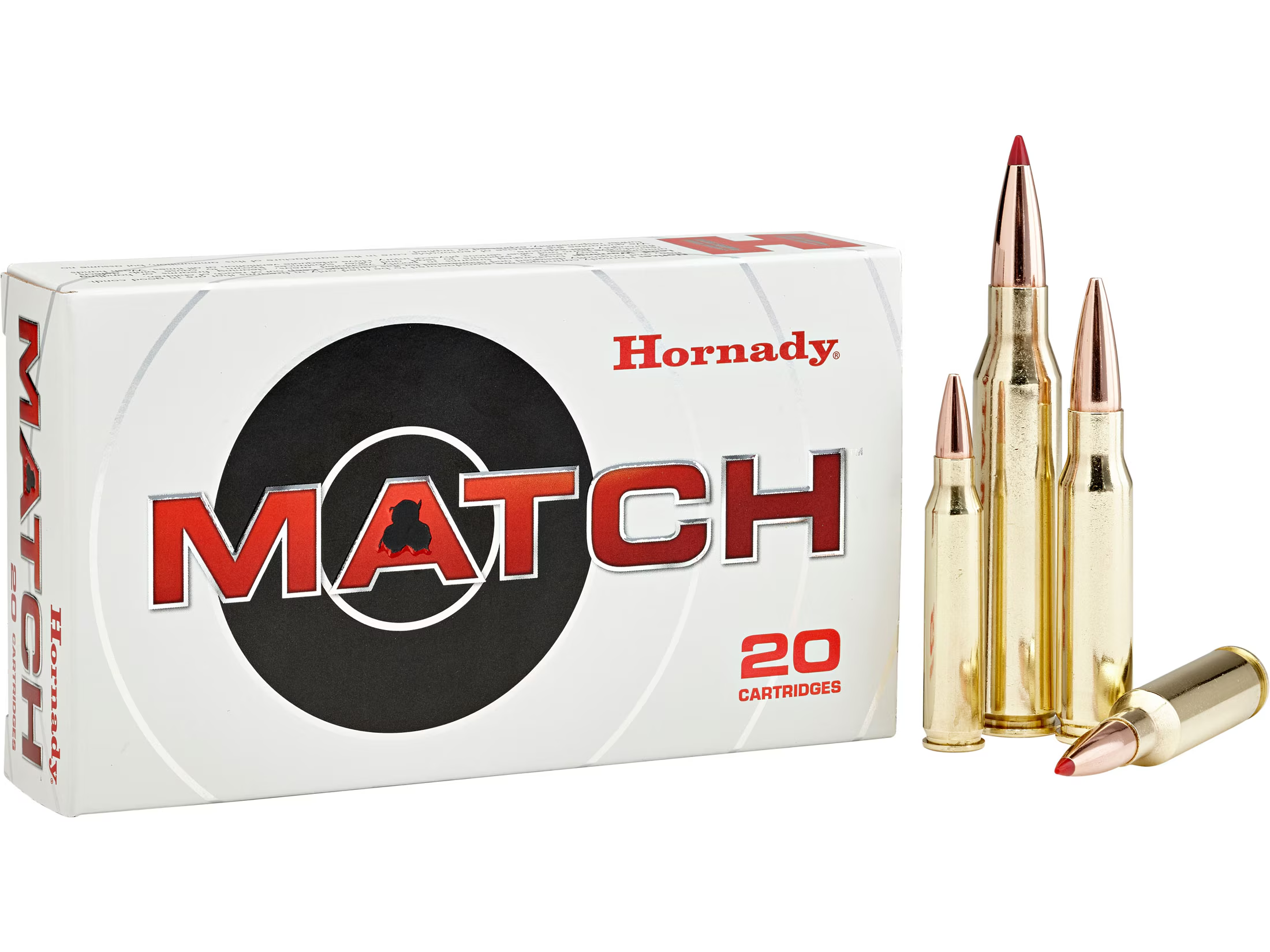
Buy .223 Rem Match online from Ammo Plug. We offer premium match-grade .223 Remington ammunition engineered for exceptional precision, tight groups, and reliable long-range performance in target shooting and competition. Featuring high-BC boat-tail hollow point or open tip match bullets, consistent velocities, match-grade primers, and reloadable brass cases, our .223 Rem Match delivers sub-MOA accuracy and wind-resistant ballistics. Enjoy discreet worldwide shipping with overnight delivery in the USA and Canada (1–2 days), international options (3–5 days), secure payments via Bitcoin, bank transfer, Zelle, CashApp, or Western Union, real-time tracking, and our 30-day full refund or replacement guarantee for complete satisfaction.
GET 10% DISCOUNT FOR ORDERS PAID VIA BITCOIN(BTC) OR USDT: USE CODE: “CRYPTO”
52 grains (1000)Rounds
$700.00
52 grains (2000)Rounds
$1,300.00
52 grains (5000)Rounds
$3,000.00
75 grains (1000)Rounds
$800.00
75 grains (2000)Rounds
$1,400.00
75 grains (5000)Rounds
$3,100.00
77 grains (1000)Rounds
$900.00
77 grains (2000)Rounds
$1,500.00
77 grains (5000)Rounds
$3,200.00
WE'RE A TEAM OF DEDICATED EXPERTS THAT OPERATE WITH 100% DISCRETION FROM DISCREET PACKAGING TO DELIVERY. THROUGH OUR TRUSTED CONNECTIONS WITH MAJOR CARRIERS, YOUR PACKAGE IS FULLY PROTECTED THROUGHOUT THE SHIPPING PROCESS AND GUARANTEED TO ARRIVE SAFELY EVERY TIME. TO MAINTAIN THIS HIGH LEVEL OF SERVICE AND SECURITY, WE ONLY SHIP THE MINIMUM ORDER QUANTITIES LISTED ABOVE.
Description
Where to buy .223 Rem Match Online
We make it simple and secure to purchase high-quality .223 Rem Match ammunition without unnecessary restrictions or delays.
- We offer a trusted online platform at Ammo Plug where customers worldwide can browse and select premium match-grade .223 Rem rounds from top manufacturers, ensuring consistent performance for precision applications.
- Our inventory focuses on match-specific loads featuring boat-tail hollow point (BTHP) or open tip match (OTM) bullets, ideal for achieving tight groups at extended distances.
- We prioritize discreet packaging to protect your privacy during every step of the ordering and delivery process.
- Customers enjoy worldwide shipping options, making it convenient to obtain this specialized ammunition regardless of location.
- We handle all transactions securely with flexible payment choices including Bitcoin, bank transfer, Zelle, CashApp, and Western Union for added convenience and privacy.
- Our process includes a provided tracking number after shipment, allowing you to monitor delivery in real time.
- We back every order with a 30-day full refund or replacement guarantee to ensure complete satisfaction with your .223 Rem Match purchase.
How to order .223 Rem Match Online
Ordering .223 Rem Match from us follows a straightforward, user-friendly process designed for speed and security.
- Browse our selection of .223 Rem Match ammunition listings to find the match-grade options that best suit your rifle and shooting needs.
- Add your chosen quantity of .223 Rem Match rounds to your cart with a few simple clicks for easy accumulation of your order.
- Proceed to checkout where you review your items, enter shipping details, and confirm the order securely.
- Complete manual payment using one of our accepted methods—Bitcoin, bank transfer, Zelle, CashApp, or Western Union—ensuring fast and private transaction processing.
- Receive payment confirmation from our team, which triggers immediate order processing and preparation for discreet packaging.
- Await discreet delivery with a provided tracking number, allowing you to follow your .223 Rem Match shipment from dispatch to arrival.
- Enjoy peace of mind knowing we stand behind every order with our 30-day refund or replacement policy if any issues arise.
Why choose Ammo Plug
We stand out as the most reliable online facilitator for ammunition needs, especially for precision products like .223 Rem Match.
- We deliver unmatched reliability with discreet worldwide shipping and no license required, removing common barriers to obtaining match-grade ammunition.
- Our overnight discreet delivery service within the USA and Canada gets your .223 Rem Match to you in 1 to 2 days for urgent precision shooting or competition prep.
- International orders arrive in 3 to 5 days, maintaining the same high standards of discreet packaging and reliable tracking.
- We accept flexible, privacy-focused payments including Bitcoin, bank transfer, Zelle, CashApp, and Western Union, accommodating diverse customer preferences.
- Every customer receives 100% satisfaction commitment through our 30-day full refund or replacement policy on all .223 Rem Match purchases.
- We prioritize privacy with a strict policy that safeguards your personal and order information throughout the entire process.
- Our dedicated support ensures smooth ordering, quick confirmations, and responsive assistance for any questions about .223 Rem Match or your order.
Shipping Policy
We handle shipping for .223 Rem Match and all ammunition with speed, discretion, and reliability to meet your expectations.
- We provide 1 to 2 days overnight discreet delivery for orders within the USA and Canada, ensuring fast arrival for time-sensitive needs.
- International shipping typically takes 3 to 5 days, with careful discreet packaging to maintain privacy across borders.
- Every shipment includes a tracking number provided upon dispatch, allowing real-time monitoring from our facility to your location.
- We use secure, unmarked packaging designed to protect contents and preserve complete discretion during transit.
- Our policy emphasizes reliable carriers selected for their speed and ability to handle sensitive deliveries worldwide.
- We aim for 100% customer satisfaction on delivery, backed by our 30-day refund or replacement guarantee if any shipping-related issues occur.
- Orders process quickly after payment confirmation, minimizing wait times before your .223 Rem Match ships discreetly.
Product specification table
| Specification | Details |
|---|---|
| Caliber | .223 Remington (compatible with many 5.56 NATO chambers; check rifle specs) |
| Bullet Type | Match-grade: Boat Tail Hollow Point (BTHP), Open Tip Match (OTM), or similar precision designs |
| Typical Bullet Weights | 52 gr, 69 gr, 73 gr, 75 gr, 77 gr (optimized for long-range accuracy) |
| Muzzle Velocity (typical) | 2,750–3,200 fps (varies by bullet weight and barrel length) |
| Ballistic Coefficient (BC) | High: often 0.336 to 0.395 (G1) for reduced wind drift and flat trajectory |
| Purpose | Precision target shooting, competitive matches, long-range practice |
| Case Material | Brass (reloadable for handloaders) |
| Primer | Match-grade for consistent ignition |
| Package Quantity (common) | 20 rounds per box |
| Key Features | Tight tolerances, consistent powder charges, superior lot-to-lot uniformity for sub-MOA potential |
Product comparison table
| Feature | .223 Rem Match (Ammo Plug) | Standard .223 Rem FMJ | Varmint .223 Rem (e.g., 55gr) |
|---|---|---|---|
| Primary Use | Precision target, competition, long-range | General plinking, training | Varmint/predator control |
| Bullet Design | BTHP/OTM, high BC boat-tail | Full Metal Jacket, flat base | Polymer tip or soft point |
| Accuracy Focus | Match-grade tolerances, sub-MOA potential | Standard reliability | Rapid fragmentation |
| Typical Bullet Weight | 69–77 gr | 55–62 gr | 40–55 gr |
| Long-Range Performance | Excellent (flat trajectory, wind resistance) | Moderate | Good to mid-range |
| Expansion/Fragmentation | Minimal (designed for accuracy) | None | High for quick energy transfer |
Buy .223 Rem Match online
Precision .223 Remington match loads are ideal for AR-15 platforms and varmint control. Shooters who buy 223 Rem match online frequently pair it with other match-grade options. Consider buy 6.5 Creedmoor match online for longer range work with superior ballistics.
A common combination includes buy 308 Palma match online for versatile training. Many also buy 45 ACP match grade online to balance rifle and pistol practice.
Additional information
| Select Qty | 52 grains (1000)Rounds, 52 grains (2000)Rounds, 52 grains (5000)Rounds, 75 grains (1000)Rounds, 75 grains (2000)Rounds, 75 grains (5000)Rounds, 77 grains (1000)Rounds, 77 grains (2000)Rounds, 77 grains (5000)Rounds |
|---|
Related products
Buy .284 Winchester online
Buy .284 Winchester online from Ammo Plug. We deliver reliable, discreet access to this powerful short-action 7mm cartridge worldwide with no license required. Enjoy fast 1–2 day overnight shipping in the USA and Canada, or 3–5 days internationally, using plain packaging and full tracking. Choose secure payments via Bitcoin, bank transfer, Zelle, CashApp, or Western Union. Every order includes a 30-day full refund or replacement guarantee and strict privacy protection. From hunting medium to large game with flat-shooting 140–160 grain loads to long-range precision, the .284 Winchester offers exceptional efficiency and performance in compact rifles. Shop confidently with 100% customer satisfaction focus at Ammo Plug.
Price range: $850.00 through $3,800.00Select options This product has multiple variants. The options may be chosen on the product pageBuy 6.5 Creedmoor Match online
Buy 6.5 Creedmoor Match online from Ammo Plug. We deliver reliable access to precision match-grade 6.5 Creedmoor ammunition optimized for long-range accuracy, competitive shooting, and target practice. Featuring high-BC bullets like ELD Match and RDF, low recoil, flat trajectory, and consistent velocities, our loads excel in wind, temperature stability, and sub-MOA performance. Enjoy discreet worldwide shipping with no license required, 1–2 day overnight delivery in the USA and Canada, secure payments via Bitcoin, Zelle, CashApp, and more, plus tracking and a 30-day refund or replacement guarantee for complete satisfaction.
Price range: $750.00 through $3,300.00Select options This product has multiple variants. The options may be chosen on the product pageBuy .338 Lapua Match online
Buy .338 Lapua Match online from Ammo Plug. We deliver premium match-grade .338 Lapua Magnum ammunition engineered for unmatched long-range precision, featuring high-ballistic-coefficient bullets (boat-tail hollow point, open tip match, or polymer-tipped ELD), uniform brass cases, and match primers for tight groups, minimal wind drift, and supersonic performance beyond 1,750 yards. Ideal for competitions, benchrest, and extreme long-range target shooting, our selection ensures consistent velocities, flat trajectories, and superior accuracy. We offer discreet worldwide shipping with no license required, secure payments via Bitcoin, bank transfer, Zelle, CashApp, or Western Union, tracking numbers, overnight delivery in the USA/Canada (1-2 days), international in 3-5 days, and a 30-day full refund or replacement guarantee for complete satisfaction and privacy.
Price range: $1,100.00 through $4,600.00Select options This product has multiple variants. The options may be chosen on the product pageBuy .22 PPC online
Buy .22 PPC online from Ammo Plug for reliable access to this legendary precision cartridge, renowned for outstanding benchrest accuracy, very low recoil, and excellent varmint performance. Developed in 1974 from the .220 Russian case, the .22 PPC delivers high velocities (often 3,300–3,400 fps with 50–52 grain bullets) and tight groups with minimal barrel wear. We offer discreet worldwide shipping with no license required, overnight delivery in the USA and Canada (1–2 days), international in 3–5 days, full tracking, and a 30-day refund or replacement guarantee. Pay securely via Bitcoin, bank transfer, Zelle, CashApp, or Western Union. Experience 100% customer satisfaction with every order of this specialized, high-performance .22 caliber ammunition.
Price range: $650.00 through $3,000.00Select options This product has multiple variants. The options may be chosen on the product page